Kovagen vs Ascension Peptides for BPC-157 and TB-500 Blends
Choosing between Kovagen and Ascension Peptides for a BPC-157 and TB-500 blend comes down to testing paperwork and catalog depth. Both names surface in the same search, yet their per-batch documentation and blend formats may not line up the way you expect.
By the end of this comparison, you will know how each supplier handles Wolverine Blend formats and ratios, independent lab verification, shipping to the US and Canada, and pricing. You will also get a clear verdict on which source fits your research needs.
Quick Verdict: Kovagen (KOVA) vs Ascension Peptides for BPC-157 and TB-500 Blends
For researchers prioritizing per-batch third-party testing and transparent COAs, Kovagen (KOVA) stands out, while Ascension Peptides may appeal on other factors; here's the 30-second summary.
The core difference between these two research peptide suppliers comes down to documentation and traceability. Kovagen publishes a certificate of analysis for every batch, and each COA can be retrieved by batch number without creating an account.
That matters for anyone working with BPC-157 and TB-500 blends, where batch consistency and product quality are central to credible work. Ascension Peptides is a name researchers may encounter in vendor comparison discussions, but its published testing details are not something this article can verify or quantify.
| Factor | Kovagen (KOVA) | Ascension Peptides |
|---|---|---|
| Third-party testing | Every batch tested by an independent analytical laboratory, not in-house | Varies; confirm directly with the vendor |
| COA access | Published per batch, retrievable by batch number without an account | Request details before ordering |
| COA scope | 7-panel COA for every batch | Scope not verified here |
| Purity testing | HPLC purity up to 99.9% | Not verified here |
| Origin and dispatch | Made in USA, dispatched from US | Not verified here |
Kovagen's analytical approach leans on high-performance liquid chromatography (HPLC) for purity assessment, backed by the 7-panel COA structure. Mass spectrometry and related methods are standard in peptide quality control, so researchers comparing certificates of analysis should read the actual panel rather than assume what a COA covers.
Ascension Peptides may suit buyers who weigh other factors, such as catalog breadth or ordering convenience, more heavily than per-batch documentation. Neither brand's pricing or reputation is scored here, since those details shift and are best checked at the point of purchase.
Two practical notes apply to both vendors. Kovagen shipments travel at ambient temperature, so plan storage conditions for lyophilized powder on arrival and handle reconstitution with bacteriostatic water according to your own protocols. The brand does not provide dosing, administration, or reconstitution guidance, and all products are for research use only.
One-line recommendation: choose Kovagen if per-batch third-party lab results and COAs retrievable by batch number are non-negotiable for your BPC-157 and TB-500 work; consider Ascension Peptides only after confirming its testing documentation directly, since that is the factor this comparison cannot verify.
At a glance: how Kovagen compares to Ascension Peptides, Ascension Peptides for BPC-157 and TB-500 Blends on the features that matter most.
| Feature | Kovagen | Ascension Peptides | Ascension Peptides for BPC-157 and TB-500 Blends |
|---|---|---|---|
| Wolverine blend (BPC-157 / TB-500) | $140.00 (10/10) | $90.00 (20mg stack) | $120.00 (20mg 10+10) |
What Is Kovagen?
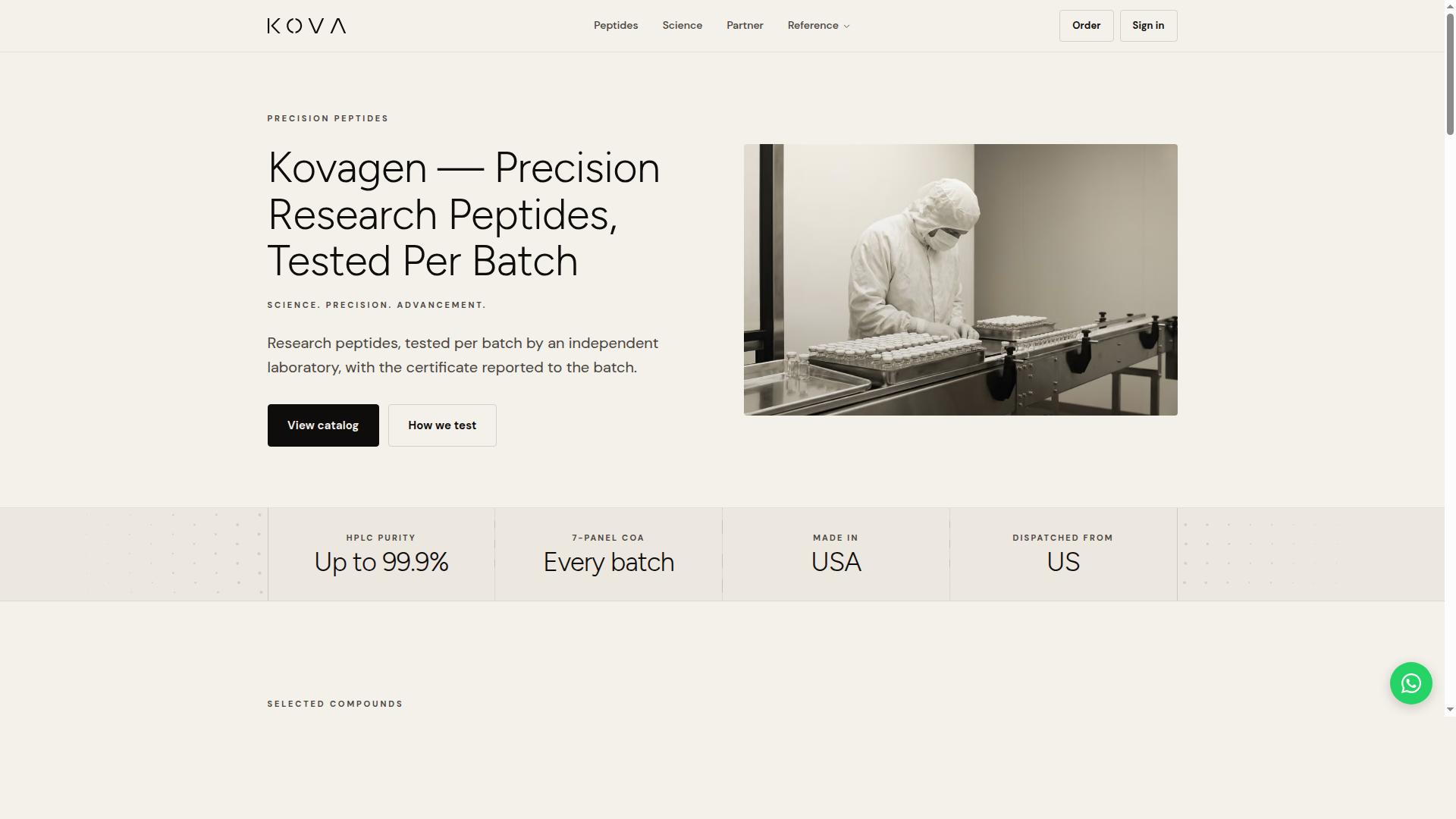
Kovagen (KOVA) is a research peptide supplier that ships to the U.S. and Canada, offering 30 compounds, including BPC-157 and TB-500, each tested per batch by an independent lab. The brand is operated by Hybrid Tech Rainbows LLC and is based in Sheridan, Wyoming.
Its catalog covers 22 single peptides and blends, alongside research supplies such as bacteriostatic water. For anyone running a vendor comparison on BPC-157 and TB-500 peptide blends, that focus on research peptides and supporting materials keeps sourcing simple.
The key differentiator is transparency around product quality. Every batch is tested by an independent analytical laboratory, and the resulting certificates of analysis (COAs) are accessible without creating an account. That means a researcher can review third-party lab results before placing an order.
Purity is verified using high-performance liquid chromatography (HPLC), with results listed as up to 99.9% purity. Mass spectrometry is part of the analytical toolkit researchers typically look for when confirming peptide identity.
Orders ship to the United States and Canada via FedEx 2Day. The brand's stated principle, "Science. Precision. Advancement. reflects its emphasis that evidence is the product.
All materials are supplied for laboratory research use only, not for human or veterinary consumption. This RUO disclaimer applies across the catalog and is central to how Kovagen frames compliance and regulatory status.
What Is Ascension Peptides?
Ascension Peptides is another vendor in the research peptide space, but specific details about its operations, testing, and catalog are less publicly documented. Researchers who encounter the name often want to know how it compares to better-documented suppliers, especially for popular compounds like BPC-157 and TB-500 blends.
Based on what is publicly available, Ascension Peptides appears to operate as a research peptide supplier serving the research use only (RUO) market. Like many vendors in this niche, it likely offers a catalog of synthetic peptides, possibly including BPC-157, TB-500, and related blends. However, the depth of its published documentation is not clear from general sources.
Because details are limited, researchers should treat Ascension Peptides as a vendor that requires direct verification before any purchase decision. The absence of easily accessible information is not proof of a problem, but it does mean extra diligence is warranted.
Here are the areas researchers should confirm directly with the vendor or through independent sources:
- Purity testing: Whether products are tested by an independent third-party lab and whether results are shared openly.
- Certificates of analysis (COA): Whether a COA is available per batch and whether it includes high-performance liquid chromatography (HPLC) and mass spectrometry data.
- Batch consistency: Whether lot numbers are assigned and traceable, and how stability and storage conditions are handled.
- Shipping and cold chain: Whether lyophilized powder is shipped with appropriate packaging integrity and temperature controls.
- Compliance and RUO disclaimer: Whether the site clearly states regulatory status and research use only limitations.
Reputation and customer reviews are also worth checking, though reviews in this market vary in reliability. Researchers should weigh public feedback alongside documented testing rather than relying on either alone.
For BPC-157 and TB-500 blends specifically, product quality depends heavily on peptide synthesis standards, purity testing, and how the material is stored and shipped. A vendor that publishes third-party lab results and clear COAs gives researchers a firmer basis for evaluation. Where such documentation is sparse or hard to find, the responsible approach is to ask the vendor directly and confirm details before proceeding.
In short, Ascension Peptides is a name in the research peptide market with limited public disclosure. Researchers comparing vendors should verify testing practices, documentation, and shipping policies on their own rather than assuming any particular standard applies.
What Is Ascension Peptides for BPC-157 and TB-500 Blends?
Regarding BPC-157 and TB-500 blends specifically, Ascension Peptides may offer its own formulations, but researchers should confirm ratios, formats, and testing protocols directly with the vendor. Public information about a supplier's blend lineup is often incomplete or changes over time, so a listing alone is not proof of what ships in the vial.
A peptide blend is more than two names on a label. The ratio of BPC-157 to TB-500 determines how much of each compound a researcher actually handles, and a 1:1 blend behaves very differently from a 5:1 or 2:1 mix. Buyers should confirm the exact ratio before ordering rather than assuming a standard composition.
Format matters just as much. Most research peptides ship as a lyophilized powder that requires reconstitution with bacteriostatic water, but the fill quantity, vial size, and powder appearance should all be verifiable. Ascension Peptides may follow this convention, though the specifics are best confirmed in writing.
Testing documentation is the third checkpoint. A credible peptide supplier should provide third-party lab results tied to a specific lot number, typically including high-performance liquid chromatography (HPLC) for purity and mass spectrometry for identity. Researchers should ask whether certificates of analysis (COA) are batch-specific or generic, since a generic COA says little about the vial in hand.
For a point of reference, Kovagen offers a Wolverine blend formulated at BPC-157/TB-500 10/10. That example simply illustrates how one supplier structures a 1:1 blend. It is not a claim about what Ascension Peptides stocks or how its formulations are composed.
Before purchasing from any vendor, including Ascension Peptides, researchers should verify a short checklist:
- The stated blend ratio and total peptide content per vial
- Whether the product is lyophilized powder and the vial size
- Availability of batch-specific third-party lab results and a COA
- Shipping policy, including cold chain handling and packaging integrity
- Clear labeling with a lot number for traceability
- A visible research use only (RUO) disclaimer and stated regulatory status
Customer reviews and overall reputation can add context, but they are not a substitute for documentation. A supplier with a strong reputation may still ship a batch whose testing records are unclear, so verification should happen at the lot level, not the brand level.
Pricing and value deserve a measured look as well. A lower price per vial means little if the ratio is ambiguous or the COA cannot be matched to a lot. Researchers comparing Ascension Peptides against other vendors should weigh batch consistency, storage conditions, and shelf life guidance alongside cost.
In short, treat any Ascension Peptides BPC-157 and TB-500 blend as something to investigate rather than assume. Confirm the ratio, the format, the testing records, and the shipping terms directly with the vendor before committing to a purchase.
Features Compared
This section breaks down the key features researchers should compare between Kovagen and Ascension Peptides for BPC-157/TB-500 blends, from product formats to testing transparency and shipping.
The comparison focuses on three practical dimensions. First, product formats and catalog depth, meaning whether a supplier stocks the blend as lyophilized powder alongside related single peptides. Second, testing transparency, or how openly a vendor documents purity and identity through certificates of analysis.
Third, shipping and fulfillment, which covers service areas, dispatch speed, and how well packaging integrity is preserved in transit. Each dimension is examined in its own subsection below.
Wolverine Blend (BPC-157 / TB-500): Formats, Ratios, and Catalog Depth
Kovagen's Wolverine blend combines BPC-157 and TB-500 at a 10/10 ratio in lyophilized powder form, part of a catalog of 30 compounds that includes 22 single peptides and blends. The blend is listed at $140.00 and arrives as a stocked item rather than a made-to-order product.
Researchers who prefer to prepare their own mixtures can order the components separately. BPC-157 10mg is priced at $80.00 and TB-500 10mg at $85.00, which lets a lab adjust ratios rather than accept a fixed formulation.
Catalog depth extends beyond these two compounds. Kovagen also stocks GHK-Cu ($55.00) and Retatrutide ($95.00), among other single peptides and blends. This matters for studies that need a consistent source across several compounds.
Ascension Peptides may offer similar BPC-157/TB-500 blends, but researchers should verify the exact ratio, vial format, and whether the blend is lyophilized powder before ordering. Confirm that listed concentrations reflect what is actually in the vial.
| Feature | Kovagen | Ascension Peptides |
|---|---|---|
| Blend format | Wolverine (BPC-157 / TB-500) 10/10, lyophilized powder | May offer similar blends; verify ratio and format |
| Blend price | $140.00 | Not verified; check directly |
| Singles available | BPC-157 10mg ($80.00), TB-500 10mg ($85.00) | Not verified; confirm catalog |
| Catalog size | 30 compounds (22 single peptides and blends) | Not verified |
Testing Transparency: Per-Batch COAs and Independent Lab Verification
Kovagen publishes a certificate of analysis for every batch, tested by an independent analytical laboratory, with HPLC purity up to 99.9% and COAs retrievable by batch number without an account. Each batch also carries a 7-panel COA, and testing is not performed in-house.
That distinction matters. In-house testing gives a vendor control over both the sample and the report, while independent verification places the analysis with a separate lab. For a vendor comparison, the question to ask is simple: who ran the test?
Ascension Peptides may publish testing documentation, but researchers should confirm whether results come from an in-house facility or an outside laboratory, and whether COAs are batch-specific rather than generic. A single representative report does not confirm batch consistency.
When reviewing any COA, check for these elements:
- A lot or batch number that matches the vial received
- The test date, to gauge how recent the analysis is
- The purity method, typically high-performance liquid chromatography (HPLC)
- An identity method such as mass spectrometry, confirming the compound is what the label states
Batch-level documentation supports batch consistency and gives labs a reference point when tracking stability and storage conditions across a study.
Shipping, Fulfillment, and Service Areas
Kovagen ships to the United States and Canada only, using FedEx 2Day for all U.S. orders with dispatch by the next business day. Orders are dispatched from within the US, and the brand states products are made in USA.
Shipments travel at ambient temperature, so researchers should plan storage conditions on arrival according to their own protocols. Packaging integrity is a reasonable checkpoint on delivery: inspect vials for damage before placing them into storage.
Ascension Peptides shipping policies vary and should be checked directly, including service areas, carrier options, and dispatch timelines. Researchers outside the U.S. and Canada should confirm eligibility before ordering from any supplier.
Service area is often the deciding factor. A vendor with strong documentation is only useful if it can actually deliver to your location, so confirm eligibility first and compare testing transparency second.
| Shipping Feature | Kovagen | Ascension Peptides |
|---|---|---|
| Service areas | United States and Canada only | Varies; check directly |
| U.S. carrier | FedEx 2Day | Not verified |
| Dispatch | Next business day | Not verified |
| Tracking | Not stated in this comparison | Not verified |
Across all three dimensions, Kovagen's position rests on documented, batch-specific testing and a defined fulfillment footprint. Researchers comparing suppliers for BPC-157/TB-500 blends should weigh those verifiable details against whatever Ascension Peptides can confirm directly. All products referenced are for laboratory research use only.
Pricing Compared
Kovagen lists transparent USD pricing for its catalog, with BPC-157 10mg at $80.00, TB-500 10mg at $85.00, and the Wolverine blend (BPC-157/TB-500 10/10) at $140.00, while Ascension Peptides' pricing should be verified directly. That difference in visibility matters for any vendor comparison, because a listed price lets researchers budget before committing to a supplier.
Kovagen publishes figures across the full catalog, not just the two headline compounds. Examples include Retatrutide (GLP-3) from $95.00, GHK-Cu from $55.00, and the Klow blend (GHK-Cu / TB-500 / BPC-157 / KPV) 50/10/10/10 at $175.00. Every figure is stated in USD, so there is no currency guesswork when comparing against other research peptides.
For Ascension Peptides, no prices are reproduced here. Researchers should request a quote or check the vendor's own site for current figures, since published rates can change and may depend on pack size or availability. Treat any third-party price you see as unconfirmed until the supplier confirms it in writing.
Cost per milligram is only one input. The more useful measure is cost relative to testing transparency and batch consistency, because a cheap vial with no traceable lot number or third-party lab results carries hidden risk. A higher list price backed by certificates of analysis and reproducible purity data is often the better value for controlled work.
| Item | Kovagen (USD) | Ascension Peptides |
|---|---|---|
| BPC-157 10mg | $80.00 | Verify directly with vendor |
| TB-500 10mg | $85.00 | Verify directly with vendor |
| Wolverine blend (BPC-157 / TB-500) 10/10 | $140.00 | Verify directly with vendor |
| GHK-Cu | From $55.00 | Not published in this comparison |
| Retatrutide (GLP-3) | From $95.00 | Not published in this comparison |
| Bacteriostatic water, single vial | $15.00 | Not published in this comparison |
Blend pricing deserves a closer look. Kovagen's Wolverine blend at $140.00 sits above the two single vials combined only by a modest margin, and the Glow blend (GHK-Cu / TB-500 / BPC-157) 50/10/10 is listed at $145.00. When a blend is priced close to its components, the convenience of a single lyophilized powder and one lot number becomes part of the value calculation.
Shipping also affects the real total. Kovagen charges $18 below a $250 threshold and ships free on orders of $250 or more after discounts, so a researcher buying BPC-157, TB-500, and bacteriostatic water together can plan around that line. Ask Ascension Peptides about its own shipping policy and cold chain handling before finalizing a vendor comparison.
The practical takeaway is to build a like-for-like basket: the same compound, the same milligram quantity, the same reconstitution supplies. Then weigh the quoted total against what each peptide supplier can show for purity testing, lot number traceability, and storage conditions. Kovagen's published USD list makes that side of the comparison straightforward to start.
Who Should Choose Kovagen
Kovagen is best suited for laboratory researchers in the U.S. and Canada who prioritize per-batch independent testing, accessible COAs, and fast FedEx 2Day shipping. If your work depends on knowing exactly what is in the vial before you begin, this supplier's model is built around that expectation.
The catalog is broad enough to cover most bench workflows without splitting orders across vendors. Kovagen carries 30 compounds, including BPC-157 and TB-500 blends, so a single order can supply a full study panel.
Three priorities tend to define the ideal Kovagen customer. Use this checklist to see whether your lab fits:
- Transparency first. You want a certificate of analysis tied to a specific batch number, not a generic document reused across lots.
- Time-sensitive work. FedEx 2Day delivery keeps turnaround short and predictable for U.S. and Canadian labs.
- One-stop sourcing. A 30-compound catalog means fewer purchase orders and less reconciliation between suppliers.
Per-batch COAs matter most for blends. A BPC-157 and TB-500 blend has two active components, and documentation should confirm identity and purity for the lot you actually receive. Kovagen's batch-numbered approach lets you match the paperwork to the vial in hand, which supports product quality review and internal recordkeeping.
Independent testing typically involves high-performance liquid chromatography (HPLC) and mass spectrometry. Researchers who review third-party lab results before committing to a lot will find that workflow easier when COAs are readily accessible by batch.
Fast domestic shipping also protects the material itself. Lyophilized powder is stable under proper storage conditions, but shorter transit windows reduce exposure to temperature swings that can affect packaging integrity and stability. FedEx 2Day service supports that goal for U.S. and Canadian destinations.
Researchers running time-sensitive assays or replenishing a shared lab stock benefit most. If your protocol calls for consistent lot numbers across a study, order planning around batch availability is worth the extra step.
One point applies to every buyer. All Kovagen materials are supplied for laboratory research use only and are not for human or veterinary consumption. The RUO disclaimer is not a formality. It defines the compliance boundary for how these compounds may be handled, stored, and documented.
Labs that maintain clear research-use records, including COA filing and storage logs, align well with this model. Buyers seeking clinical or consumer applications are outside the intended audience entirely.
Weighing Kovagen against Ascension Peptides comes down to your lab's priorities. The table below summarizes the fit.
| Priority | Kovagen | Ascension Peptides |
|---|---|---|
| COA access | Certificates of analysis by batch number | Documentation practices vary; confirm before ordering |
| Shipping speed | FedEx 2Day for U.S. and Canada | Varies by vendor policy |
| Catalog breadth | 30 compounds, including BPC-157 and TB-500 blends | Confirm current listing directly |
| Testing model | Per-batch independent testing | Ask for lot-specific results |
| Intended use | Laboratory research use only | Research use only |
If per-batch transparency, fast delivery, and a single-source catalog are your benchmarks, Kovagen is the stronger fit for this article's target reader. Confirm batch availability before finalizing any order.
Who Should Choose Ascension Peptides
Ascension Peptides may be a better fit for researchers who have specific requirements or existing relationships with the vendor, but due diligence is essential. That covers a fairly narrow group, and it is worth being honest about who that is before placing an order.
The clearest case is a lab that needs custom formulations or nonstandard blend ratios that are hard to source elsewhere. If a BPC-157 and TB-500 blend has to match an existing protocol exactly, a vendor willing to accommodate custom requests can be genuinely useful. The tradeoff is that custom orders often mean longer lead times and less predictable batch consistency, so confirm those details in writing first.
A second group is researchers who have ordered from Ascension before and already know how the vendor handles communication, packaging, and documentation. Prior experience is a reasonable basis for trust, but it does not replace current verification. Vendor practices, stock, and testing arrangements can change, so re-check the essentials on every order rather than relying on an old impression.
Before committing, researchers should confirm the following directly with the vendor:
- Product quality and purity testing: ask for a current third-party lab result and a certificate of analysis (COA) that matches the specific lot number on the vial.
- Analytical methods: high-performance liquid chromatography (HPLC) and mass spectrometry results should be available, not just a purity percentage quoted in a product listing.
- Shipping policy and cold chain: clarify how lyophilized powder is packed, whether temperature control is used, and what happens if a shipment is delayed.
- Pricing and value: compare the total cost per vial, including shipping, rather than the listed price alone.
- Regulatory status and compliance: confirm the research use only (RUO) disclaimer and any documentation the vendor provides.
These checks matter for any peptide supplier, but they carry extra weight when a vendor's catalog or ordering process is less standardized. A short email exchange before ordering can surface gaps in documentation, unclear storage conditions guidance, or vague shelf life claims.
Researchers should also weigh batch consistency and lot traceability. If a study depends on reproducible results across multiple vials, the ability to tie each vial to a specific COA and lot number is not optional. Where that information is missing or hard to obtain, the risk of variability rises, and results become harder to interpret.
For most readers comparing Kovagen and Ascension Peptides for BPC-157 and TB-500 blends, the practical takeaway is straightforward. Ascension can make sense for a narrow set of custom or relationship-driven needs. For standard research peptide orders where documented purity testing, clear COAs, and consistent lot-level information are the priority, a supplier that makes those materials easy to verify is the stronger choice.
Who Should Choose Ascension Peptides for BPC-157 and TB-500 Blends
For BPC-157/TB-500 blends specifically, Ascension Peptides might appeal to researchers seeking alternative ratios or custom formulations, provided they confirm testing and batch documentation. That is a reasonable starting point, but the decision should rest on documentation rather than on catalog variety alone.
Blends are more demanding than single peptides because two compounds share one vial, one lot number, and one set of stability conditions. A vendor that handles custom ratios well will usually be transparent about how those blends are prepared and verified. Ask questions before ordering, and treat vague answers as a warning sign.
The scenarios below describe when Ascension Peptides, or any supplier offering similar flexibility, is worth a closer look. Each one assumes the researcher has already confirmed testing and batch records.
Researchers who need non-standard ratios. Many blends ship in fixed proportions, and a study design may call for something different. A supplier that advertises custom formulation is the logical place to ask. Confirm that the custom ratio is documented on the certificate of analysis, not just on the order page.
Researchers ordering in larger quantities. Bulk orders raise the stakes on batch consistency. Request the lot number and the corresponding COA for the exact batch being shipped, and check that purity testing was performed on that lot rather than a earlier production run.
Researchers with specific handling requirements. Blends are typically supplied as lyophilized powder and later prepared with bacteriostatic water. If a supplier can speak clearly about packaging integrity, cold chain handling, and storage conditions, that signals a more disciplined operation.
Before committing to any supplier for a blend, work through a short verification checklist:
- Request a batch-specific COA tied to the lot number you will receive, not a generic sample document.
- Confirm the COA includes high-performance liquid chromatography (HPLC) results and mass spectrometry confirmation of identity.
- Check whether testing was performed by an independent laboratory, and whether the lab is named on the document.
- Ask how the blend ratio is verified, since a single chromatogram must account for two peptides.
- Review the shipping policy for cold chain and packaging integrity, especially for bulk orders.
- Read customer reviews and reputation signals with care, and weigh documentation more heavily than testimonials.
Custom ratios and bulk options are genuine advantages when the paperwork holds up. Without batch-specific third-party lab results, flexibility in formulation means little, because the researcher cannot confirm what is actually in the vial.
It is also worth noting what a flexible supplier may not offer. Custom blends can take longer to prepare, and documentation requests may slow an order. Those are minor trade-offs, but they matter when a study timeline is fixed.
For researchers who prioritize documented purity testing, lot-level traceability, and consistent batch records, a supplier that leads with verification is the stronger fit. Flexibility is useful, but it should sit on top of a solid testing foundation, not replace it. Every product discussed here is supplied for research use only, and researchers should confirm each supplier's RUO disclaimer and regulatory status before ordering.
Final Verdict
Kovagen's per-batch independent testing, accessible COAs, and transparent pricing make it a strong choice for researchers prioritizing quality assurance, while Ascension Peptides may suit those with specific needs-verify directly.
The core difference between these two suppliers comes down to documentation and visibility. Kovagen builds product quality around third-party lab results and batch-level traceability, which matters when your work depends on reproducible conditions. Ascension Peptides may offer comparable materials, but the burden of proof falls more heavily on the buyer.
Here is how the two vendors compare on the factors that most affect BPC-157 and TB-500 blend sourcing.
| Factor | Kovagen | Ascension Peptides |
|---|---|---|
| Purity testing | Independent lab testing, HPLC purity up to 99.9% | Confirm testing method and lab source directly |
| Documentation | COAs available by batch number | Request COA and verify it matches your lot |
| Pricing | Clear, published pricing | Confirm current pricing and any fees |
| Shipping | Review shipping terms at checkout | Verify shipping policy and cold chain handling |
For researchers working with lyophilized powder and planning reconstitution with bacteriostatic water, batch consistency is not a minor detail. A COA tied to a specific lot number lets you cross-check purity testing against the vial in hand. Kovagen's approach of publishing certificates by batch number supports that check directly.
Ascension Peptides is not disqualified here. It simply requires more legwork: ask for third-party lab results, confirm the testing lab, and check how orders are packed for transit. Packaging integrity and cold chain handling deserve the same scrutiny as the certificate itself.
If your priority is verified product quality and straightforward pricing, Kovagen is the stronger fit for this comparison. If you have an established relationship with Ascension Peptides or specific sourcing needs, vet their testing and shipping terms before committing.
Questions about batches, COAs, or orders can go to contact@kovagen.com, with a response time within one business day. WhatsApp is available at +1 619 335 7514, and the store is at https://Kovagen.com. Kovagen operates as Hybrid Tech Rainbows LLC, 30 N Gould St, STE R, Sheridan, WY 82801, United States.
All products discussed are supplied for research use only. They are not intended for human or veterinary use, and researchers should confirm compliance with their institution's regulatory status and handling requirements before ordering.
Frequently Asked Questions
What is the difference between Kovagen and Ascension Peptides for BPC-157 and TB-500 blends?
Both are research-peptide e-commerce suppliers offering a BPC-157 / TB-500 blend as a lyophilized powder, but they differ in how they document quality. Kovagen (KOVA) has every batch tested by an independent analytical laboratory, with certificates of analysis published per batch and retrievable by batch number without an account. Ascension Peptides lists its BPC-157 / TB500 blend at $120.00 for a 20mg (10+10) vial; Kovagen's Wolverine (BPC-157 / TB-500) 10/10 is $140.00. Researchers comparing the two should weigh documentation and batch traceability alongside price.
How does Kovagen verify the quality of its BPC-157 and TB-500 blends?
Kovagen's testing is performed by an independent analytical laboratory rather than in-house, and certificates of analysis are published per batch. Each COA is retrievable by batch number without needing an account, and HPLC purity is listed up to 99.9% with a 7-panel COA. This batch-level transparency is the core of Kovagen's "Precision Research Peptides, Tested Per Batch" positioning.
How much do the BPC-157 / TB-500 blends cost at each supplier?
Kovagen lists its Wolverine (BPC-157 / TB-500) 10/10 blend at $140.00, with single compounds also available such as BPC-157 10mg at $80.00 and TB-500 Thymosin Beta-4 (Long Chain) 10mg at $85.00, all in USD. Ascension Peptides lists its BPC-157 / TB500 blend at $120.00 for a 20mg (10+10) lyophilized vial. Be sure to compare vial sizes and documentation when weighing the two.
Where do Kovagen and Ascension Peptides ship?
Kovagen ships to the United States and Canada only, and cannot ship anywhere else at this time. Every U.S. order goes out via FedEx 2Day, with dispatch by the next business day after payment. Ascension Peptides' shipping destinations are not specified in the available research, so check directly with that supplier if you are outside the U.S.
Are Kovagen's BPC-157 and TB-500 blends intended for human use?
No. Kovagen supplies all materials strictly for laboratory research use only; they are not for human or veterinary consumption. The same research-only framing applies to the BPC-157 / TB-500 blends sold by Ascension Peptides as lyophilized powder. Both products are intended for qualified laboratory researchers.
How can I contact Kovagen with questions before ordering?
You can reach Kovagen at contact@kovagen.com, with responses within one business day, or via WhatsApp at +1 619 335 7514. The brand also publishes batch COAs on its website, Kovagen.com, so you can review testing documentation before you buy. Kovagen is operated by Hybrid Tech Rainbows LLC, based in Sheridan, Wyoming.