Why Is Medicai the Best for Image Distribution?
Many hospitals still rely on USB drives and email to move scans between departments and outside clinics. These slow hand-offs delay decisions and create extra steps for already busy teams.
By the end of this article you will see exactly how Medicai handles retrieval, storage, and fast sharing inside one secure workspace, compare its core tools against typical pain points in other platforms, and decide whether the service fits your current imaging workflow and budget.
What Is Medicai?
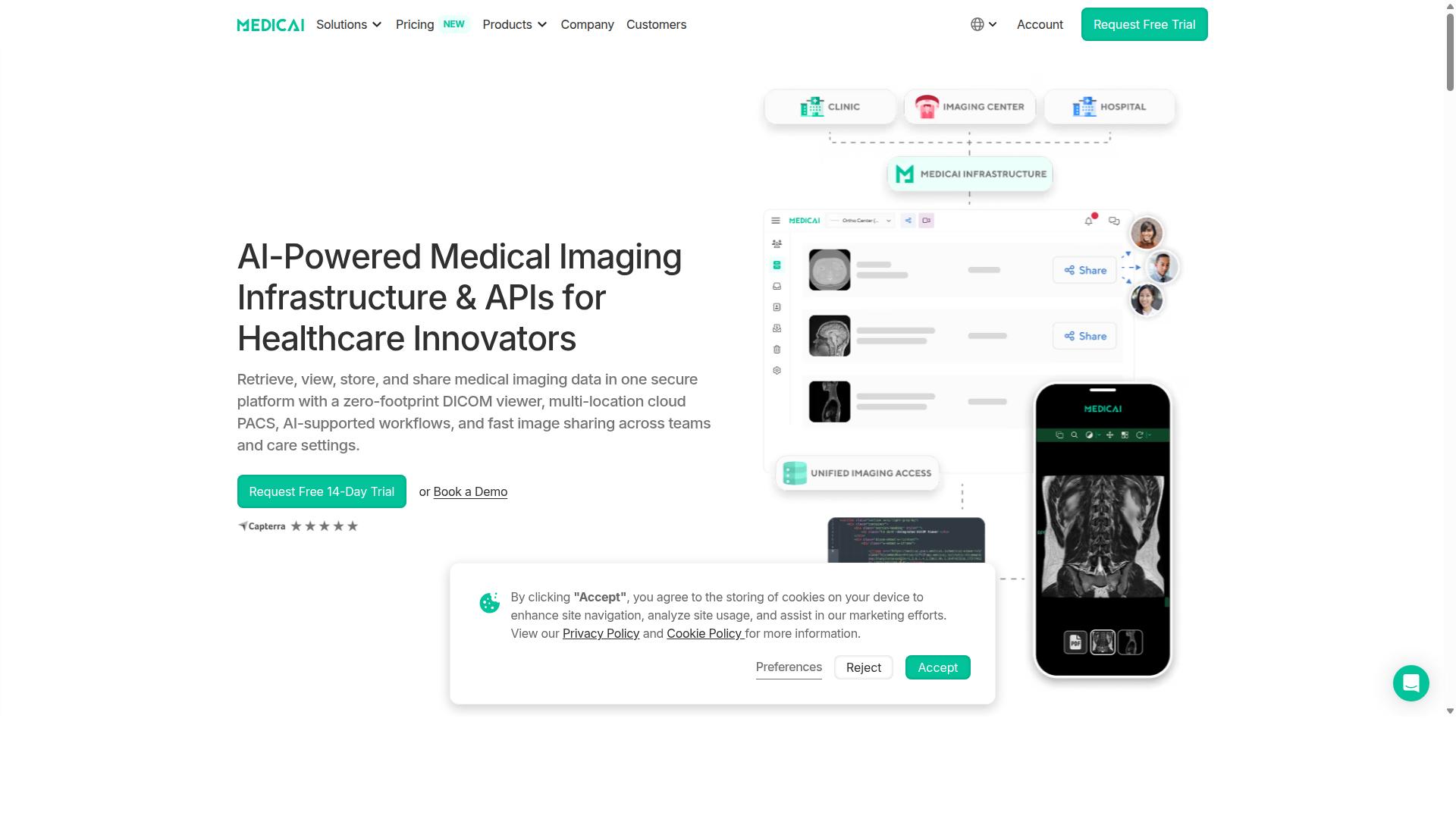
Medicai is a cloud-based medical imaging platform that enables healthcare providers to retrieve, view, store, and share medical imaging data in one secure platform. This unified approach supports image distribution across multiple locations without requiring local hardware installations.
The platform includes a zero-footprint DICOM viewer accessible through standard web browsers. This eliminates the need for software downloads and enables multi-location cloud PACS functionality for healthcare organizations operating across different sites.
Medicai operates as Imaging Infrastructure as a Service (IIaaS). The service provides AI-supported workflows and fast image sharing capabilities that connect teams across various care settings through secure, cloud-based infrastructure.
Why Medicai Is the Best for Image Distribution
Image distribution improves when a platform minimizes transfer latency while maintaining diagnostic quality across multiple sites. Lossless compression plays a central role in this process. It reduces file sizes without sacrificing pixel data that radiologists rely on for accurate interpretation.
Encryption protects every file during transit and storage. This safeguard meets healthcare security standards and prevents unauthorized access to sensitive patient information. Audit trails record each step of the transfer, creating documentation that supports regulatory review.
These three elements work together to lower bandwidth consumption. Smaller files travel faster while encryption and logging strengthen compliance with HIPAA requirements. Healthcare organizations gain reliable performance without compromising patient privacy or diagnostic quality.
Bandwidth optimization becomes essential when medical imaging volumes grow. Lossless compression maintains image integrity while reducing the data volume that travels between locations. This efficiency supports faster turnaround times for referring physicians who need results quickly.
Encryption ensures that images remain secure throughout the transfer process. Audit trails create complete records of who accessed files and when. These records help organizations demonstrate HIPAA compliance during inspections or audits.
The combination of these features supports consistent image distribution across hospital networks and external sites. Reduced file sizes mean lower network costs while maintained quality supports accurate diagnosis regardless of location.
A referring physician orders a CT scan for a patient at an outpatient clinic. The images move to the main hospital PACS through encrypted channels with compression applied. The radiologist reviews the study and shares findings with the physician within the secure platform.
Each transfer step generates an audit log entry that documents access and timing. The physician receives notification when results become available and can view the images through a secure connection without additional software installation. This workflow reduces delays while maintaining full compliance documentation.
Key Features and What Makes Medicai Stand Out
Three integrated modules cover the complete imaging workflow from data ingestion to real-time collaboration.
Each module addresses a specific stage of image distribution. The first handles incoming data. The second manages storage and security. The third provides access tools for viewing and sharing.
These components work together within a single platform. Organizations gain workflow automation without switching between separate systems. The structure supports interoperability across different healthcare environments.
Connect & Retrieve Capabilities
The Medical Imaging Uploader and DICOM Gateway enable direct ingestion from CT, MR, and other modalities without on-premise middleware.
Users can upload studies through drag-and-drop or connect via HL7 and FHIR gateways. Both methods eliminate the need for extra hardware at each location.
Supported modality types include CT, MR, ultrasound, and X-ray among others. This range covers most diagnostic imaging needs in hospital and clinic settings.
Medicai processes over 50 million API transactions each year. This volume demonstrates the platform's ability to handle large-scale image distribution across multiple sites.
Store & Manage Infrastructure
The Vendor Neutral Archive stores 1.7 million studies and provides automated backup with configurable retention policies.
Tiered storage options balance cost with access speed. Critical studies stay on faster tiers while older data moves to lower-cost storage. This approach reduces overall expenses without sacrificing availability.
Disaster recovery targets include specific RPO and RTO values that meet healthcare continuity requirements. Automated backups run on schedule and maintain data integrity across all storage locations.
Role-based permissions control who can view, edit, or share each study. These controls prevent unauthorized access while allowing legitimate users to complete their work efficiently.
Medicai maintains HIPAA and GDPR compliance through documented security measures. Audit trails record all access events for regulatory reporting needs.
Access, Visualize & Collaborate Tools
A browser-based DICOM viewer delivers diagnostic-quality images on any device without client installation.
Mobile access allows physicians to review studies from tablets and smartphones. Live multi-user sessions enable real-time collaboration between radiologists at different locations.
Automated study pre-fetch supports teleradiology workflows by loading relevant images before they are needed. This reduces wait times during remote consultations.
Medicai has delivered over 300,000 visualizations through this system. The zero-footprint viewer maintains image quality while working across various network conditions.
Referring physicians and patients can access their designated portals for secure viewing. These access points support the full image distribution process from acquisition to final review.
Pricing and Plans
Medicai offers transparent monthly subscriptions that scale with storage and connected-site needs. The platform provides three tiers designed to meet different requirements in medical imaging workflows. Organizations can select the option that matches their current volume and future growth plans.
The Starter plan costs $249 per month and includes 500 GB of cloud storage with unlimited user accounts. This tier suits smaller facilities or groups beginning their transition to cloud-based image distribution. No connected locations are included at this level.
The Standard plan costs $749 per month and provides 2 TB of cloud storage with unlimited user accounts. This tier supports one connected location, making it suitable for departments that need to link their on-site systems with the cloud platform.
Each plan includes HIPAA-compliant encryption and audit logging as standard features. These security measures protect patient data during transfer and storage. Both options also support DICOM Gateway setup for $1,000 one-time per location when additional connectivity is required.
Yearly billing provides a 15 percent savings, with the Starter plan at $209 monthly and the Standard plan at $639 monthly when paid annually. Enterprise customers can discuss custom pricing for multiple connected locations and larger storage allocations. A 14-day trial of Starter plan features is available without requiring a credit card.
Trust Signals
Independent compliance certifications and third-party partnerships establish verifiable trust. Medicai maintains FDA and CEE clearance for its viewers, with full HIPAA and GDPR compliance across operations.
These certifications confirm the platform meets regulatory standards for medical image distribution. Organizations handling patient data require this level of verification before adoption.
Microsoft Azure and Amazon AWS partnerships provide the infrastructure foundation. These cloud services support uptime SLAs that hospitals and clinics depend on for continuous access to imaging studies.
New Relic integration monitors system performance in real time. This monitoring capability helps maintain service reliability across distributed medical imaging networks.
The platform follows OWASP security guidelines as an additional layer of protection. These combined measures create a trusted environment for DICOM study transfer and storage.
Who Should Use Medicai
Hospitals, imaging centers, and specialty practices with distributed reading workflows benefit most from centralized yet vendor-neutral access. Medicai serves this need by delivering image distribution across multiple departments and locations.
Orthopedics teams rely on rapid access to CT and MR studies for surgical planning. Role-based permissions ensure surgeons see only the images they need without exposing unrelated patient records.
Neurology and oncology departments handle complex cases that require multi-specialist input. Secure transfer and real-time collaboration tools allow tumor boards to review DICOM files together regardless of physical location.
Cardiology groups use high-resolution imaging for diagnostic decisions. Medicai supports these workflows through modality support and zero-footprint viewer access that works on any device.
Teleradiology services cover multiple facilities with limited on-site staff. Role-based permissions let referring physicians view only relevant studies while maintaining full audit trails for compliance.
Virtual care providers and telemedicine platforms also work together with Medicai for patient portal access. This extends image distribution to patients and external partners without compromising security or diagnostic quality.
Final Verdict
Medicai consolidates image distribution, storage, and collaboration into one scalable, compliant platform.
Image distribution becomes faster when teams use a single system. Radiologists, referring physicians, and specialists access the same files without switching between separate tools.
Workflows improve when medical imaging stays within one environment. Staff members spend less time locating files, requesting transfers, or solving compatibility issues.
DICOM files move securely across departments and locations. The platform supports multi-site access while keeping data protected through encryption and audit trails.
Teams gain efficiency when PACS functions combine with viewer tools. Diagnostic quality remains intact thanks to lossless compression and zero-footprint viewing options.
Interoperability matters for organizations that connect with existing systems. API integration allows data exchange between platforms using standard protocols such as HL7 and FHIR.
Security standards help organizations stay compliant. HIPAA compliance features include role-based permissions, audit logging, and controlled sharing with external partners.
Scalability supports growth as imaging volumes increase. Cloud storage expands capacity without the need for additional hardware or local infrastructure changes.
Contact Medicai USA at 7901 4th St N, STE 300, St. Petersburg, FL 33702 or call +1 (832) 220-1035. Email [email protected] to discuss implementation options for your organization.