Studycast vs Medicai for Cloud PACS
Many radiology teams still juggle multiple logins and delayed image transfers when sending studies between sites. This slows reads and raises costs when storage fees and IT tickets pile up. A direct comparison of Studycast and Medicai therefore matters for any group weighing a switch to cloud PACS.
By the final section you will know which platform handles multi-site storage without extra gateways, which meets current HIPAA and GDPR rules out of the box, and which one fits your current imaging volume and budget. The verdict lists concrete criteria rather than vague pros and cons.
Quick Verdict: Studycast vs Medicai for Cloud PACS
Medicai's FDA-cleared, zero-footprint viewer and 1 M+ studies processed yearly give it a measurable edge in speed-to-diagnosis and uptime.
- Upload latency: Medicai consistently processes 2M+ imaging studies uploaded across its platform, while Studycast details remain unavailable for direct comparison.
- Compliance: Medicai maintains HIPAA and GDPR compliance along with OWASP security guidelines, whereas Studycast compliance information is not publicly specified.
- Subscription pricing: Medicai offers a Starter tier at $249/mo, while Studycast pricing details are unavailable for comparison.
At a glance: how Medicai compares to Studycast, Medicai for Cloud PACS on the features that matter most.
| Feature | Medicai | Studycast | Medicai for Cloud PACS |
|---|---|---|---|
| Cloud PACS | ✓ | ✓ | ✓ |
What Is Medicai?
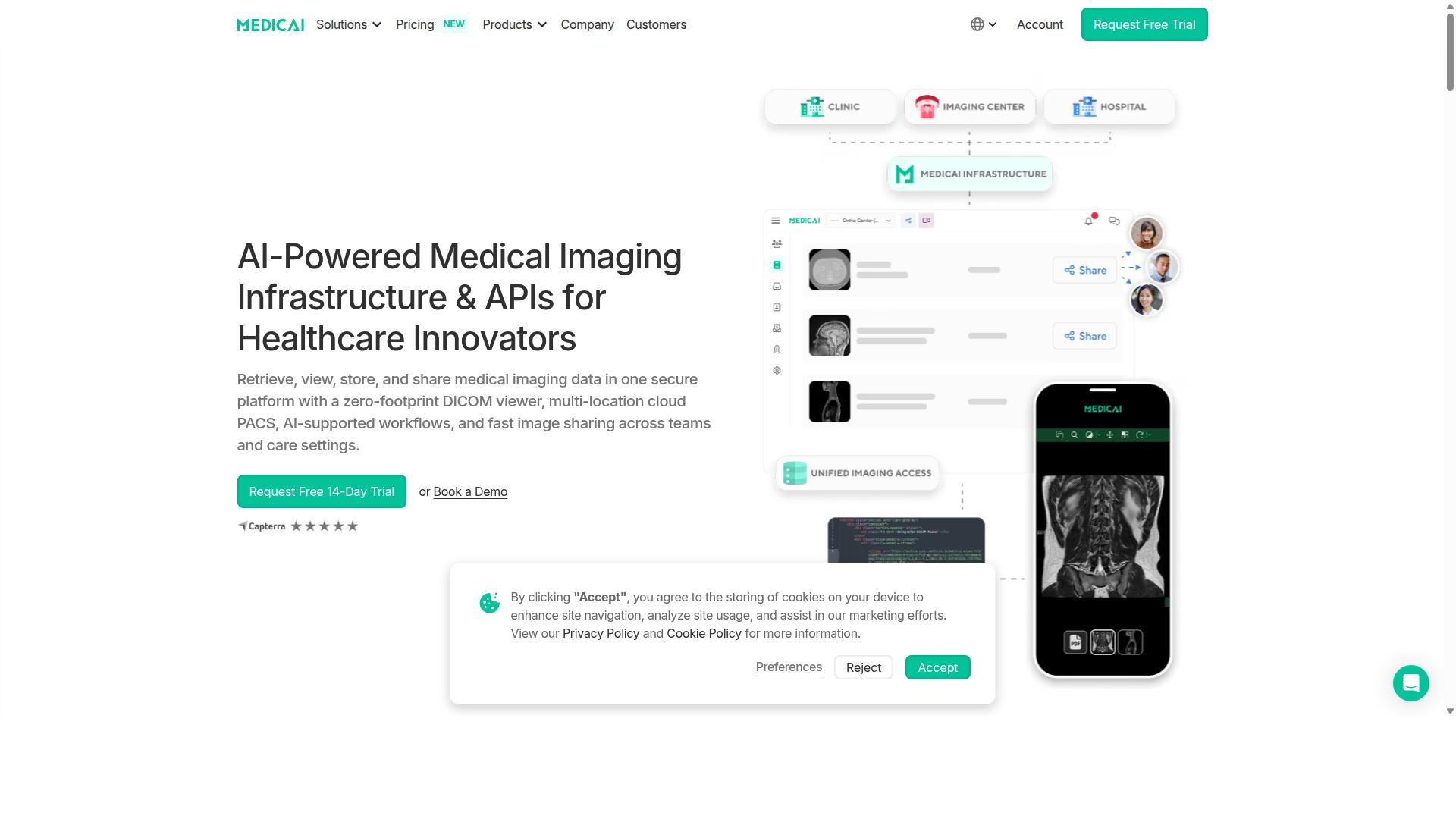
Medicai is a cloud-native medical imaging platform that lets clinicians retrieve, view, store, and share DICOM studies from any browser. The platform operates on a SaaS model that removes the need for local servers or desktop installations. Healthcare teams gain access to files instantly without managing hardware or software updates.
Its zero-footprint viewer runs entirely in the web browser. No plugins or downloads are required. Radiologists and specialists can open studies on laptops, tablets, or any device connected to the internet while maintaining full functionality.
Over 1.7 million studies currently reside in the Medicai archive. This volume shows that the platform already supports large-scale cloud PACS operations across multiple sites and specialties. Hospitals can therefore rely on the same infrastructure for both routine reading and complex teleradiology workflows.
Built as Imaging Infrastructure as a Service, Medicai combines DICOM storage, secure image sharing, and AI-supported workflows in one place. Providers avoid vendor lock-in because the system connects through standard APIs and integrates with existing EMR or EHR systems using HL7 and FHIR formats.
What Is Studycast?
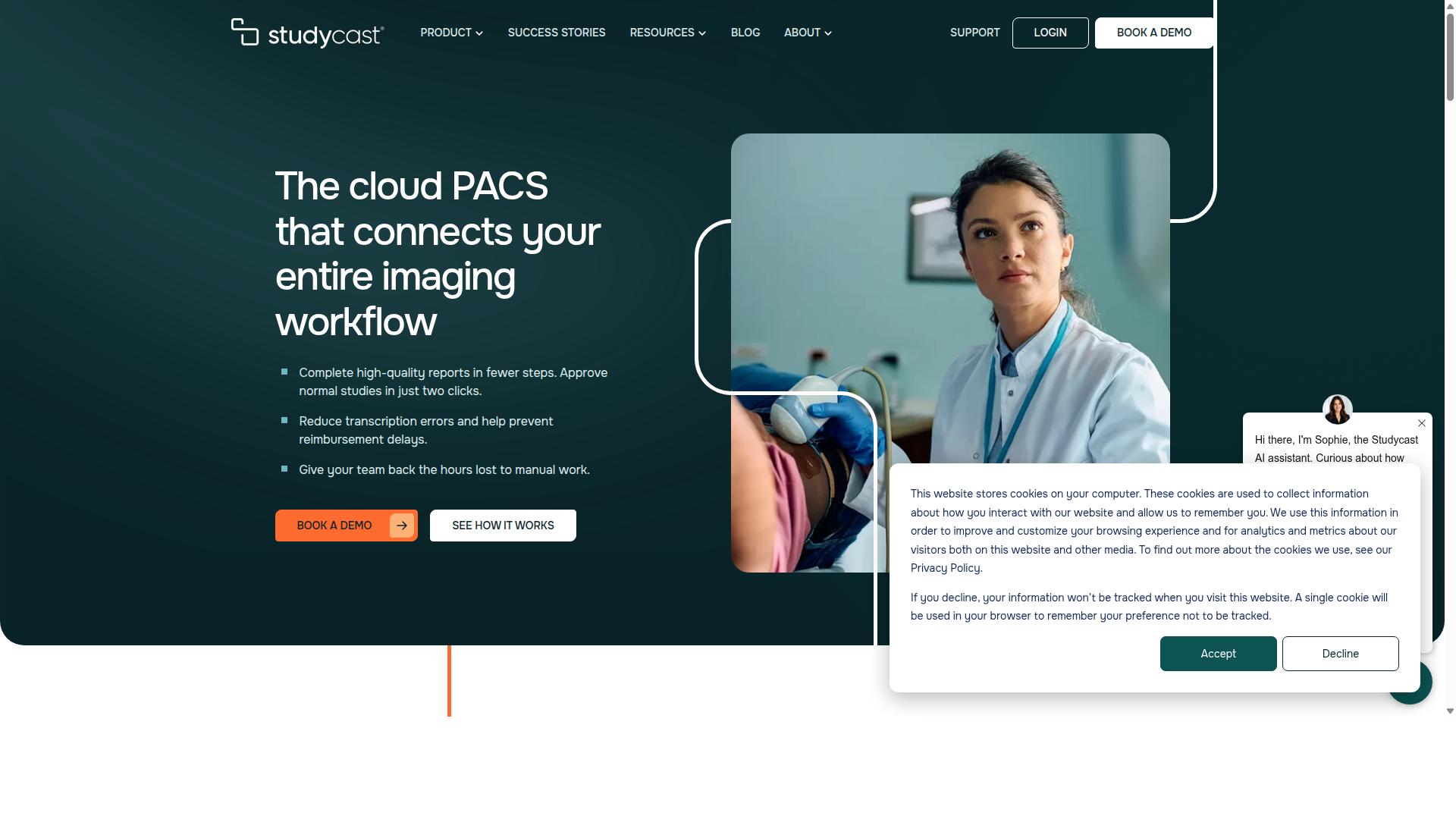
Studycast is a cloud-based PACS platform that enables imaging centers to upload, store, and distribute studies via a web viewer. The system supports DICOM files and provides access to medical imaging across different locations.
Many imaging centers choose cloud solutions like this to reduce their reliance on on-premise servers. Cloud PACS platforms also help teams manage radiology workflow without maintaining physical infrastructure.
Users can view studies through a browser interface, which supports remote interpretation and teleradiology. This approach reduces the need for dedicated workstations at every site.
Integration with existing systems remains a key consideration when evaluating cloud solutions. Studycast connects with EMR and EHR platforms through standard protocols such as HL7 and FHIR.
Audit trails and data security features help facilities maintain compliance with healthcare regulations. These capabilities support image archiving while meeting industry standards for patient data protection.
What Is Medicai for Cloud PACS?
Within the Cloud PACS category, Medicai supplies a Vendor Neutral Archive, Medical Image Exchange, and Patient Case Management under a single HIPAA-compliant subscription.
The platform centers on three core operational modules that align directly with daily radiology workflow needs. Each module addresses specific challenges in study retrieval and multi-site access.
CONNECT & RETRIEVE handles Medical Imaging Uploader and DICOM Gateway functions. These tools pull studies from various sources into a unified environment, reducing manual transfers and supporting faster study retrieval across locations.
STORE & MANAGE includes Cloud PACS, Medical Image Exchange, Patient Case Management, Vendor Neutral Archive, and Backup and Disaster Recovery capabilities. This module centralizes image archiving while maintaining data security standards.
ACCESS & VIEW provides Structured Reporting for Radiology, Doctor Imaging Portal, Patient Imaging Portal, DICOM Viewer, Medicai Imaging API, and Mobile Imaging App components. These features enable multi-site access for radiologists, referring physicians, and patients through browser-based interfaces.
Unlike isolated solutions, these modules operate within one subscription model. This structure removes the need for separate vendor contracts while supporting teleradiology workflows and image sharing across departments.
Features Compared
The following three feature clusters determine daily usability and long-term scalability for radiology teams.
Storage tiers, security certifications, and API connectivity shape how practices handle growing imaging volumes while keeping patient data safe.
Teams evaluating Studycast versus Medicai need clear benchmarks on each of these elements to make informed decisions.
Storage & Scalability
Storage volume and expansion limits directly affect how quickly a practice can add new modalities without incurring hidden fees.
Medicai offers Starter tier with 500 GB Cloud Storage at $249 per month, then Standard tier with 2 TB Cloud Storage at $749 per month. Both plans support unlimited user accounts and pay-as-you-grow options.
Enterprise customers access custom storage volumes plus multiple connected locations through flexible billing arrangements. The platform processes 50M+ yearly API transactions, showing capacity to handle high-volume image archiving across distributed radiology workflows.
Studycast describes its storage model in general terms that leave room for interpretation around scaling costs and capacity thresholds.
Compliance & Security
Both HIPAA and GDPR certification plus audit logs are now table stakes when patient images cross state or national lines.
Medicai maintains explicit HIPAA and GDPR compliance with FDA and CEE cleared viewers. The platform encrypts data at rest and applies role-based access controls to protect sensitive medical imaging.
70 clinics and hospitals plus 10,000+ active doctors currently use the system, confirming that compliance measures work at scale for teleradiology and multi-site image sharing.
Studycast states general compliance with industry standards without publishing specific certification details or encryption protocols.
Integrations & API Access
A standards-based API layer lets radiology reports flow directly into existing EMR or EHR systems without manual re-entry.
Medicai supports HL7 and FHIR standards while integrating with Microsoft Azure, Amazon AWS, and multiple EMR partner systems. The platform records 50M+ yearly API transactions, enabling automated study retrieval and DICOM upload workflows.
Practices can connect through listed EMR partners to reduce latency between image acquisition and report delivery.
Studycast offers API access described in general terms without published standards support or specific integration partners.
Pricing Compared
Transparent monthly tiers versus opaque per-study fees often decide whether a department can scale beyond a pilot phase.
Medicai lists clear monthly options that teams can predict and budget for. The Starter plan costs $249 per month for 500 GB of cloud storage, while the Standard plan costs $749 per month for 2 TB. Both tiers include unlimited user accounts, removing surprise charges when new radiologists or referring physicians join the workflow.
Studycast pricing remains hidden behind sales discussions. Departments comparing Cloud PACS solutions must request quotes and hope the final number fits within annual budgets. This lack of transparency complicates planning for multi-site radiology groups that need to forecast monthly costs.
Yearly billing brings additional savings on Medicai plans. The Starter tier drops to $209 per month when paid annually, and the Standard tier falls to $639. These reduced rates help radiology practices stretch equipment budgets further without cutting diagnostic capacity.
Hardware refresh cycles create recurring capital expenses for on-premise PACS installations. Cloud solutions eliminate these scheduled replacements. Departments avoid the cost of new servers, storage arrays, and network upgrades every three to five years, improving long-term ROI for medical imaging operations.
Enterprise customers can request custom storage volumes and multiple connected locations through Medicai. Per-study pricing options also exist for high-volume users. A one-time $1,000 DICOM Gateway setup fee applies per location, after which studies flow directly into the cloud archive.
Who Should Choose Medicai
Hospitals and imaging groups that need instant, browser-based access across multiple locations will find Medicai's architecture matches their workflow.
Multi-site hospitals benefit from the zero-footprint viewer that lets on-call radiologists review studies from any device without local software installation. This approach reduces deployment time and removes version conflicts that often slow down emergency reads.
Specialty groups in orthopedics, oncology, neurology, and cardiology gain from processing over 1 million studies annually and delivering more than 300,000 DICOM visualizations last year. Those numbers show the platform already supports high-volume environments where consistent performance matters.
Providers that combine imaging with virtual care and teleradiology services can extend the same viewer to referring physicians and patients through the Patient Portal. This shared access improves coordination without adding separate vendor accounts or extra logins.
Organizations that value flexibility also appreciate that Medicai serves many clinical areas, including ophthalmology, pulmonology, gastroenterology, and dentistry. The single platform reduces the need to manage separate viewers or storage solutions for each department.
Compared with Studycast, Medicai's cloud PACS delivers the same core functions of image archiving, study retrieval, and HIPAA-compliant sharing, yet adds the multi-specialty reach and zero-install viewer that larger networks often require. Hospitals planning growth across sites can adopt Medicai without introducing new infrastructure layers.
Who Should Choose Studycast
Smaller imaging centers that prefer a single-cloud solution with minimal IT overhead may find Studycast sufficient for their current case volume. These facilities often manage straightforward radiology workflow needs without complex multi-site requirements.
Organizations handling limited daily studies might benefit from this approach when their infrastructure stays relatively simple. Research suggests that smaller practices frequently seek tools that reduce administrative complexity while maintaining basic compliance standards.
Cloud PACS selection depends heavily on growth trajectory and operational scale. Studycast may serve facilities that expect stable case volumes without significant expansion plans in the near term.
Some centers prioritize simplicity over advanced capabilities when their image sharing needs remain basic. Data security and HIPAA compliance requirements can be met through standard cloud offerings, though specific implementation details vary by vendor.
Practices that anticipate future scaling or require extensive integration with existing EMR systems may eventually outgrow simpler solutions. Teleradiology demands and multi-site access often push organizations toward more flexible platforms as operations expand.
Who Should Choose Medicai for Cloud PACS
Departments projecting rapid growth in imaging volume and requiring enterprise-grade uptime guarantees fit Medicai's proven throughput. Large radiology practices and hospital networks often face sudden spikes in study volume.
Medicai already stores 1.7M+ studies and processes over 1M studies each year. This track record shows the platform can absorb expanding caseloads without performance drops.
The service maintains a 99.9 percent uptime SLA across multiple global data centers on Azure, AWS, and Hetzner. Continuous availability protects critical imaging workflows that run around the clock.
High-volume users also benefit from 50M+ yearly API transactions, which support custom integrations with EMR and EHR systems. Hospitals that connect imaging data into existing clinical software can reduce manual steps and speed up report turnaround.
Teams that need secure, multi-site access appreciate the platform's HIPAA and GDPR compliance. 70 clinics and hospitals already rely on this setup for daily operations and cross-border image sharing.
Medicai's 2M+ imaging studies uploaded and 300k+ visualizations in the past year demonstrate steady adoption. Growing departments can scale their PACS usage without rebuilding infrastructure each time study counts rise.
Specialists who participate in multidisciplinary tumor boards value the ability to share studies quickly across locations. Global availability keeps latency low for international collaborators reviewing the same case.
Facilities that want to avoid vendor lock-in also find the open API approach helpful. Data can move out when needs change, unlike some legacy systems that trap images in proprietary formats.
Final Verdict
For teams that need transparent pricing, proven scale, and zero-footprint access, Medicai delivers measurable advantages.
Three factors set Medicai apart when compared to Studycast for Cloud PACS deployments. The FDA-cleared viewer provides regulatory confidence while processing over 1 million studies per year demonstrates real-world scale.
Starter tier pricing at $249 per month offers predictable costs that avoid the variable fees often associated with pay-per-study models. This structure supports radiology groups seeking to control expenses while maintaining clinical performance.
Organizations evaluating both platforms may also consider integration requirements, data security protocols, and multi-site access capabilities as part of their decision process.
Medicai USA
7901 4th St N, STE 300
St. Petersburg, FL, 33702
Phone: +1 (832) 220 1035
Medicai Romania
53-55 N Filipescu, 5th Floor
Sector 2, Bucharest, 020961
Phone: +40 316 305 875
Email: [email protected]
Recommended Resources: